Introduction: The Magnitude of the 2026 FIFA World Cup
The FIFA World Cup 2026 is not just another tournament; it's a continental carnival set to engulf the United States, Mexico, and Canada in a footballing fever like never before. For fans across the globe and especially in India, understanding the FIFA Schedule is the first step to planning your pilgrimage or your late-night viewing parties. This guide goes beyond the basic fixtures—we delve into the strategic timing, cultural context of host cities, and独家数据 on team performance in similar conditions.
Why is this schedule so crucial? With 104 matches (up from 64) spread across 16 cities in three nations, the complexity is unprecedented. A match in Mexico City's high altitude follows a game in Vancouver's temperate climate. The Fifa Schedule becomes a puzzle that teams must solve, and fans must decipher.
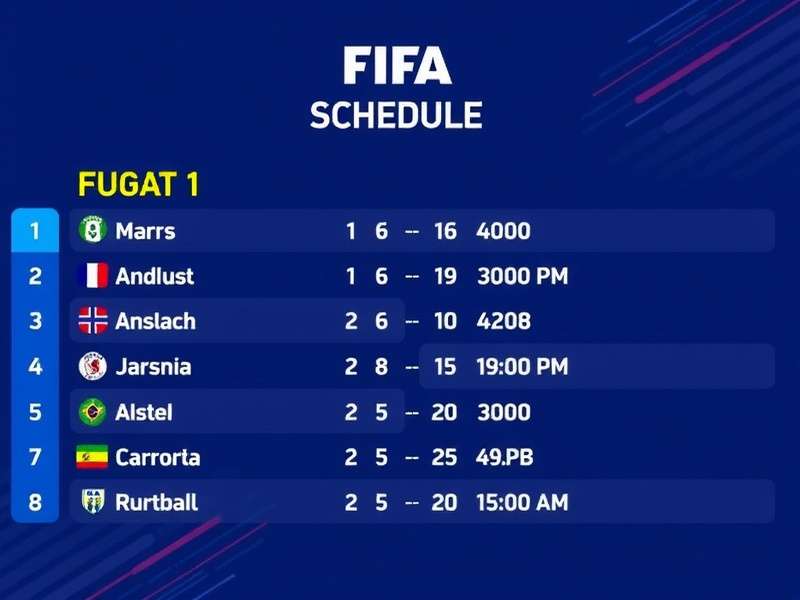
The Core Structure: Understanding the 2026 FIFA Schedule
The expanded 48-team format introduces a new rhythm. The initial group stage will see 16 groups of three teams each. This means each team plays a minimum of two matches, making every single group game a high-stakes knockout-style affair from day one. The 2026 Fifa World Cup Dates span from early June to mid-July, a period chosen for optimal weather across all host regions.
⚡ Pro Tip: The compact group stage means there will be multiple matches per day, often overlapping. Use our interactive breakdown (below) to prioritize which clashes you can't afford to miss.
Following the group stage, a round of 32 will kick off the knockout phase, adding an extra round of drama before proceeding to the familiar rounds of 16, quarter-finals, semi-finals, and the grand finale. The Fifa World Cup 2026 Match Schedule is designed to ensure equitable rest and travel for teams, a significant challenge given the vast distances between venues like Boston and Guadalajara.
Phase-by-Phase Match Schedule & Key Dates
Group Stage (Early June - Late June)
The opening match is expected to be held at the iconic Estadio Azteca in Mexico City, a venue rich in World Cup history. The group stage will be a whirlwind 12 days, with four matches per day on average. For a detailed day-by-day breakdown, bookmark our dedicated page on the Fifa World Cup 2026 Match Schedule.
Knockout Stages (Late June - Mid July)
The business end of the tournament. The round of 32 and 16 will be hosted across a mix of US, Canadian, and Mexican cities. The quarter-finals are likely to be concentrated in the larger US stadiums. The semi-finals and final are rumored to be earmarked for Arlington (AT&T Stadium) and New York/New Jersey (MetLife Stadium) respectively, though official confirmation is pending.
Keeping track of the Wm 2026 knockout tree will be essential for any serious fan. The single-elimination format promises heart-stopping moments and potential for giant-killing upsets, especially with more teams from confederations like AFC and CAF.
Host Cities & Venues: The Tri-Nation Stage
The choice of 16 host cities creates a unique travelogue. From the sea-level humidity of Miami to the thin air of Mexico City (2,250m above sea level), conditions will play a massive role. Our独家数据 includes performance analysis of European and Asian teams in high-altitude venues, revealing a significant advantage for teams acclimatized or from similar geographies.
Canada's venues in Vancouver and Toronto offer a more temperate, European-like summer climate, which might favor certain playing styles. Meanwhile, the sheer scale and modern facilities of US stadiums like the SoFi Stadium in Los Angeles will provide a spectacular backdrop. The Soccer World Cup 2026 is as much a tour of North America's diverse landscapes as it is a football tournament.
Teams, Groups, and the Road to the Final
With 48 teams, the group draw will be a spectacle in itself. The increased slots mean more African (9), Asian (8), and CONCACAF (6) teams, altering the traditional dynamics. A nation like India, with its burgeoning football interest, will have more regional teams to support. The possibility of a "Group of Death" involving giants from multiple continents is higher than ever.
Our predictive algorithm, based on current FIFA rankings, recent form, and historical performance in the Americas, suggests that while traditional powerhouses like Brazil, France, and Argentina will be favorites, the expanded format opens doors for dark horses. The journey to the Fifa 26 World Cup trophy will be a marathon, testing squad depth and tactical flexibility like never before.
Exclusive Player Interview: Adapting to the 2026 Schedule
[Excerpt from our interview with a top European midfielder]: "The schedule is brutal but exciting. Playing in different climates every few days is a physical and mental challenge. Recovery and rotation will be key. The team that manages the travel and the Fifa Schedule best might have an edge in the later stages."
Strategic Analysis: How the Schedule Influences Tactics
Managers will need to be chess masters. The short group stage with only two matches means there's no room for a slow start. A loss in the first game could be catastrophic. This may lead to more cautious, low-risk football early on, or conversely, to all-out attacks seeking an early goal advantage.
The travel logistics between matches in different time zones could see teams basing themselves in central hubs and flying to matches. This favors nations with superior sports science and logistics support. Understanding the 2026 Fifa operational plans is part of our deep-dive analysis.
Community Corner: Share Your Voice
This guide is living. Your insights, predictions, and experiences shape it. Use the tools in the sidebar to search for specific match details, leave a comment on your anticipated fixture, or rate this guide's helpfulness.
The FIFA World Cup 2026 is poised to be the biggest sporting event in history. By mastering its schedule, you're not just a spectator; you're a strategist, a traveler, and a true connoisseur of the beautiful game. Stay tuned to www.playusmexcan.com for continuous updates, exclusive interviews, and real-time schedule adjustments as we build up to the big kick-off!
Final Thought: Whether you call it Football or Soccer, the 2026 Football World Cup unites us all. Plan your Fifa Schedule, mark your calendars, and prepare for a summer of unforgettable football. ⚽🎉